
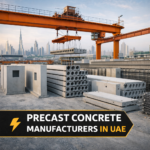
In the oil and gas industry in UAE, Precast Concrete Bunkers offer several advantages. Precast Concrete Bunkers have a number of benefits to the Oil and Gas industry in UAE.
The UAE is not only a desert country blessed with oil — it is one of the world’s most energy markets of strategic importance. There is a plan in place to reach 5 million bpd by 2030 and the infrastructure needed to support that is massive. Refineries, storage area, pipelines, processing plants, all of it must be protected. Serious protection. The type you don’t want to skimp on. This is where precast concrete bunkers come into the picture and this is why the use of precast concrete bunkers in UAE is not being taken lightly these days.
If you’ve ever asked yourself this question: “Why are leading energy operators in the UAE more and more turning to precast concrete instead of steel or cast-in-place alternatives,” then you’re in for a treat.
What Is a Precast Concrete Bunker?
Now, the precast concrete bunker is not the underground movie set that people envision (although that’s a pretty tough concept to get out of your head). Industrial – A reinforced concrete structure that is produced in a controlled factory environment and delivered & installed on site. It is like playing with LEGO, but every brick is several tonnes in weight and can withstand the impact of a blast. One of the greatest strengths of the controlled manufacturing process is what we will be discussing shortly.
The Oil and Gas industry in UAE requires specialized protection for a number of reasons.There are a number of reasons why Oil and Gas industry in UAE requires specialised protection
Oil and gas work is not a particularly safe line of business. Flammable hydrocarbons, high pressure systems, extreme temperatures and chemical exposure are a normal part of facilities’ everyday lives. Materials are also subject to other stresses in the UAE climate, such as high summer temperatures, which can regularly reach over 45°C, and changes in humidity levels, as well as coastal salt air, especially at offshore or near-shore facilities. Nothing but a well constructed steel structure will hold up, even the most well constructed. Precast concrete is more resistant to corrosion in aggressive industrial settings, has a much longer service life than metal structures and has a much higher degree of fire resistance which means that the cost of protecting metal structures is less. That’s no small benefit either; in the oil and gas industry, that comes down to a facility that can last for decades or one that requires constant upkeep and eventual replacement.
What do you mean by durable in the UAE?
So, let’s discuss durability, as this is where precast concrete truly lives up to its reputation. Precast concrete is widely used in fuel containment tanks and industrial storage tanks due to its ability to withstand corrosion, weather conditions, chemicals, and long-term damage. Given the UAE’s harsh conditions, including those that involve exposure to petrochemical spills, H₂S hazards, and saline air, this chemical resistance is paramount for oil and gas operators.
Chemical additives included in precast concrete make it resistant to weather effects, acid, alkalis, seawater corrosion, sulfate attacks, and other harmful factors which were not practical to include at the site level due to sourcing and cost considerations. This implies a precast bunker that is built now at a refinery close to Ruwais or Fujairah, is designed to deliver performance over a long life, and not only over the short term.
Precast concrete is also non-combustible, and offers excellent fire resistance, which is superior to many materials and is excellent in extreme weather conditions including cold weather, high humidity, etc. The fire-resistance factor is enough to make this choice for anyone working in the vicinity of hydrocarbon storage or processing equipment.
The time required to construct the project — Downtime Costs Money!
This is a really good fact to know for oil and gas project managers: precast concrete bunkers are quick. The panels are produced away from site, and site preparations are completed at the same time. This parallel workflow will shorten the project time considerably. The key advantage of precast concrete is a faster project delivery time, which is in line with the short time-limits of mega projects in the GCC countries.
The UAE precast market is expected to reach USD 0.94 billion by 2020 due to increased demand, which is attributed to the advantages it has over other construction methods in terms of quality, durability, project timeline compression, site disruption, safety concerns and sustainability. All of those are not hollow promises. Whether designing a new storage facility or upgrading an existing one, the faster the installation, the sooner the facility opens and the sooner the returns are realized by oil and gas operators. When one day of lost production can cost hundreds of thousands of dollars in the production process, the speed matters.
Withstands air pressure, wind, and flying debris in high-risk areas.Resists high impact and air pressure in high risk areas
By themselves, oil and gas facilities are high consequence environments. All of this can be catastrophic if buildings are not properly designed to both contain and absorb the impact of a fire, pressure or even an outside security breach. Precast concrete walls are able to be engineered to meet the highest possible safety standards, such as UL 752 level 10 ballistic resistance, fire resistance, crash resistance and physical intrusion, protecting critical energy infrastructure.
Modular blast resistant buildings set the benchmark in terms of construction speed, flexibility and scalability, cost, safety and protection for industrial protection projects in high risk environments such as oil and gas refineries. If your UAE operator requires compliance with ADNOC specifications, and international engineering codes, then the possibility of a precast solution that is both blast resistant, fire resistant and structurally sound is a very attractive proposition.
Reliability in the long term.Cost Efficiency throughout the Life Cycle
The up-front cost is one discussion. But lifecycle cost is a different — and much more significant — one. Precast concrete bunkers can be maintained with very little effort when compared with their steel counterparts. The absence of maintenance makes concrete a more cost-effective and competitive material, with more efficient overall performance.
Low maintenance precast design involves the application of corrosion-resistant concrete material, which significantly cuts down on costs, and no frequent repairs, providing high ROI through minimizing lifecycle costs and compliant design in high-risk environments such as energy installations and plants. Fact is precast concrete is not only cost competitive in theory, but in practice in a Gulf environment when you consider the savings in cost of repainting, anti-corrosion, structural repair and eventual replacement of steel structures.
Supporting the energy infrastructure of the UAE to grow and flourish
The amount of energy investment taking place in the UAE, is simply massive. ADNOC is carrying out a significant expansion at the Upper Zakum offshore field, one of the world’s biggest oil assets, which will increase production to 1.2 million bpd. The Ruwais LNG project will ramp up the country’s LNG production capacity more than double it to 15 Mtpa, once it starts operation in 2028. The scale of such a project requires materials and systems that can be installed in a timely manner and that are dependable and meet the high standards for construction and safety in the UAE.
The government agencies, like DEWA, SEWA, ADVEA, and ADNOC have their own pre-defined specifications for precast products, and they scrutinize the product quality and specifications through the procurement process. When project certifiers and regulators are involved, manufacturers supplying products to operators that meet these standards give them the assurance they are looking for. It’s not only about building a strong structure, it’s building a structure that the energy sector in the UAE can rely on.
Environmental Considerations
Sustainability is not just a “buzz word” in the UAE construction industry anymore, it is a procurement criterion. Rapid urbanization, expanding infrastructure, and the increasing prevalence of sustainable construction solutions are driving growth in the Middle East precast concrete market. Precast production cuts waste generated on site, helps to control noise and dust emissions at certain industrial sites, and enables the precast maker to improve the efficiency of the materials used thanks to a quality-control system at the factory. Precast bunkers make a positive impact on a project’s environmental performance for operators striving to meet ADNOC’s stated sustainability objectives.
Middle East Precast Market: The Numbers Speak
The market data confirms the increasing trend towards precast solutions in the area. The Middle East precast concrete market size is valued at USD 6.73 billion in 2024 and is expected to grow at a CAGR of 7.6% from 2025 to 2033, reaching USD 12.85 billion by 2033. Major factors driving demand are growing government spending on infrastructure, vibrant real estate growth and industrial growth in areas like oil and gas, healthcare and hospitality. The figures reported here are not mere guesses, but are the true decisions of engineers, project managers and procurement teams across the UAE and throughout the GCC.
Conclusion
Precast concrete bunkers in UAE offer much more than structural defense. They provide a more intelligent, faster, cheaper and more compliant solution to the infrastructure needed to support the UAE oil and gas industry. Precast concrete meets every requirement that counts in a demanding industrial environment – ranging from blast resistance and fire performance to corrosion resistance, and quick deploy. With the UAE’s energy goals to reach 5 million bpd by 2030 and double LNG capacity by 2028, the need for proven protection solutions with high performance will continue to increase. Precast concrete bunkers are not the fad. They are quickly becoming the norm in the UAE’s oil and gas sector.