get in touch

About Us
Our commitment to quality and customer satisfaction sets us apart. Whether you’re planning a small project or a large-scale construction, we have the solutions you need.
Contact Us
- Call Us: +971558516532 / +971565200005
- Email: info@srcprecasts.com
- Address: Umm Al Quwain, Al Raafah Sector 5, Umm Dera Area Number 2, Plot 1353

Precast Concrete Chamber Supplier in UAE
- Home
- Precast Concrete Chamber Supplier in UAE
Transforming landscapes with over 3 years of experience.

About Us
Our commitment to quality and customer satisfaction sets us apart. Whether you’re planning a small project or a large-scale construction, we have the solutions you need.
Contact Us
-
Call Us: +971565200005
Call Us: +971558516532
Email: info@srcprecasts.com

Our Facilities
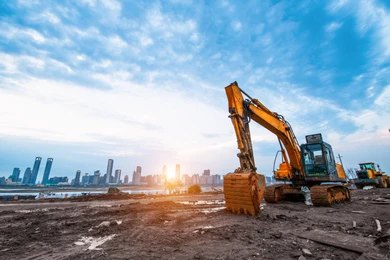
At SRC Precast, our state-of-the-art facilities are equipped with cutting-edge technology to manufacture precast systems with precision and efficiency. Our facilities not only meet but exceed industry standards, enabling us to provide customized solutions that meet the unique requirements of any project.
Our Staff
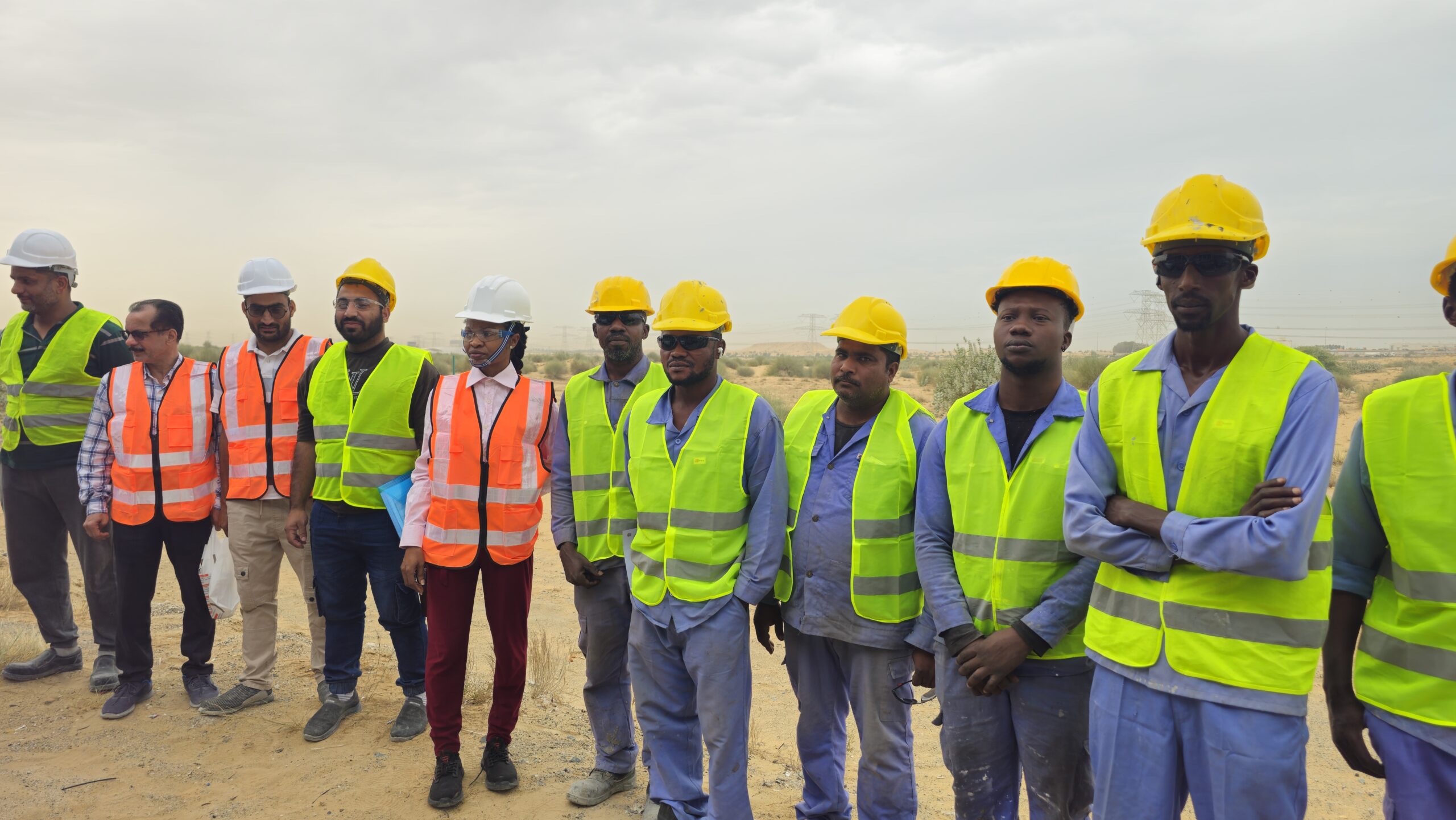
Our team consists of experienced professionals dedicated to delivering exceptional solutions for your construction needs. From design experts to project managers, our staff is passionate about innovation and committed to maintaining the highest standards of quality and service. At SRC Precast, we work as a united team to ensure that every project is executed with precision and care.

Our Plans
We are committed to growth and continuous improvement. Our plans include expanding our capabilities to support larger, more complex projects, while maintaining our unwavering focus on quality and sustainability. By collaborating with clients, partners, and industry leaders, we aim to stay at the forefront of the precast construction industry, delivering value-added services that contribute to long-term success.
Precast Concrete Chamber Supplier in UAE — Factory Direct from SRC Precasts
SRC Precasts, the manufacturing division of Solid Rock Concrete Works based in Umm Al Quwain, supplies precast concrete chambers directly from its own casting yard to contractors, developers, utility authorities, and government projects across the United Arab Emirates. As a factory-direct producer, we remove the layers of trading and mark-up that typically sit between a project and the product it needs, and we replace them with a single point of contact: our own engineering, casting, curing, and logistics teams working from one facility.
Precast concrete chambers form the backbone of almost every underground utility network in the country — from the cable ducting that feeds a new industrial estate to the drainage systems that carry stormwater away from a coastal highway. Because these structures are buried, invisible once installed, and expected to perform without maintenance for decades, the margin for error is small. A chamber that is undersized, poorly reinforced, or cast with the wrong concrete grade does not fail gracefully; it fails underground, where repair is expensive and disruptive. That is the core reason contractors across the UAE increasingly specify precast over cast-in-situ construction for chamber works, and it is the reason we have built our business around consistent, factory-controlled production rather than one-off site casting.
This page sets out everything a specifier, contractor, or procurement team needs to evaluate precast concrete chambers before ordering: what they are, the types available, full technical specifications, our manufacturing and refurbishment process, indicative pricing, the industries we serve, our delivery coverage across all seven emirates, and the reasons project teams choose to work with us directly. Wherever a number or specification is quoted below, treat it as a general guide — every project has its own loading, soil, and access conditions, and our engineering team will always confirm the final specification against your drawings before casting begins.
1. What Are Precast Concrete Chambers?
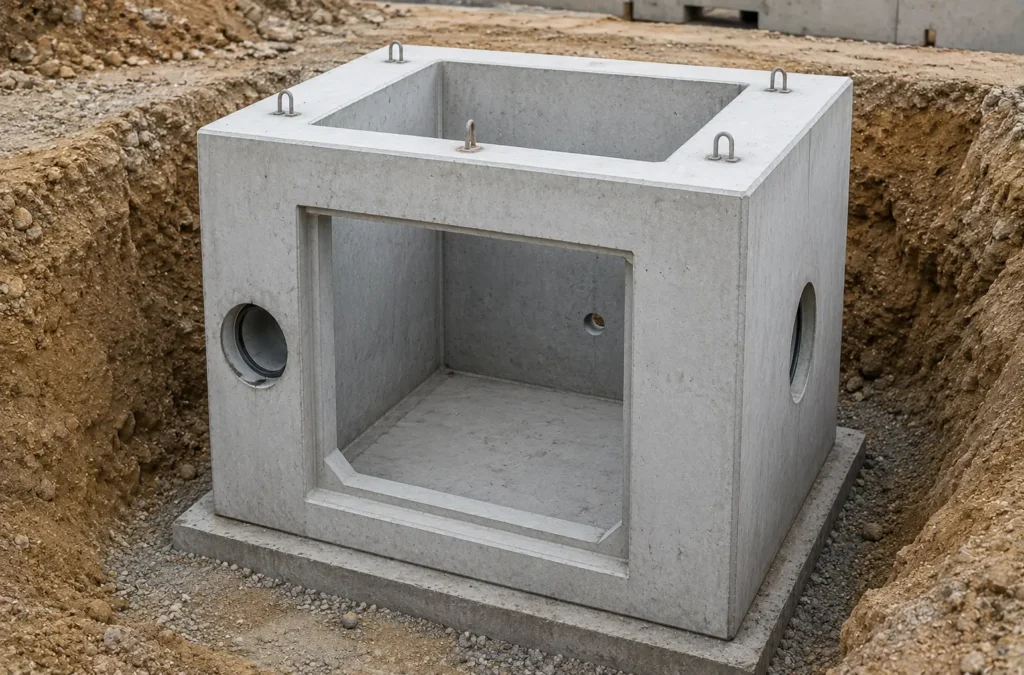
A precast concrete chamber is a factory-manufactured, below-ground concrete enclosure used to house, protect, access, or connect underground utility infrastructure. Instead of building a chamber from formwork and wet-poured concrete on site, the entire structure — base, walls, and sometimes the roof slab — is cast in a controlled factory environment, cured to full design strength, and then transported to site as a finished or semi-finished unit ready for installation.
The purpose of a chamber varies by application, but the underlying function stays the same across almost every use case: it creates a protected, accessible void below ground level so that cables, pipes, valves, meters, or drainage connections can be installed, inspected, maintained, or repaired without disturbing the surrounding ground or structure. A cable chamber, for example, gives utility technicians a safe access point to join, terminate, or test underground power and telecom cables. A valve chamber houses an isolation valve on a water or gas main so that it can be operated and serviced without excavation. A drainage or inspection chamber allows stormwater and foul drainage networks to be jetted, rodded, and CCTV-surveyed for blockages.
Precast construction has become the default choice for these structures across the UAE for a combination of technical and commercial reasons. Factory casting allows concrete to be poured under consistent temperature and humidity conditions, using calibrated batching equipment and the same mix design on every unit — something that is very difficult to guarantee on a live construction site, particularly during the summer months when high ambient temperatures can affect curing and long-term durability of site-cast concrete. Precast units also arrive on site already cured to specification, so installation time is measured in hours rather than the days or weeks required for formwork, pouring, and curing in situ. For contractors working to tight programme deadlines on RTA, municipal, or private development projects, that difference in install time is often the deciding factor.
Precast chambers are manufactured as either monolithic single-piece units for smaller sizes, or as modular sectional units — base, wall rings or panels, and cover slab — that are assembled on site using sealed joints for larger or deeper installations. Both approaches are engineered to the same structural performance standards; the choice between them is generally driven by depth, access constraints on site, and transport logistics rather than by any difference in final quality.
Because chambers sit underground and are subject to soil pressure, groundwater, surface traffic loading (in the case of chambers under roads or hardstanding), and in many UAE locations exposure to saline groundwater and sulphate-bearing soils, the concrete mix design and reinforcement detailing used in a precast chamber is a genuine piece of structural engineering, not a generic concrete box. This is the area where factory-direct manufacturers differentiate themselves from general concrete suppliers or resellers — the engineering behind the mix design, cover depth, and reinforcement detailing is what determines whether a chamber is still performing to specification in year twenty, not just on the day it is installed.
It is worth understanding the joint interfaces used in sectional chambers, since this is often the detail that separates a chamber that stays watertight for decades from one that develops infiltration problems within a few years. Sectional joints between rings, panels, or between a base unit and the first wall section are typically detailed with a rubber gasket seal, a cementitious joint fill, or a combination of both, chosen based on the groundwater exposure at the installation depth. A joint that is correctly detailed and correctly installed on site should perform as a continuous watertight barrier for the design life of the structure; a joint that has been poorly detailed, or correctly detailed but poorly installed, is one of the more common sources of chamber underperformance reported on UAE infrastructure projects. This is part of why our engineering team pays close attention to joint detailing at the design stage, and why we provide clear installation guidance with every sectional chamber order.
Another point worth clarifying for anyone new to specifying precast chambers is the distinction between the chamber structure itself and the fittings installed inside or on top of it. The chamber is the structural concrete enclosure; the cover and frame, step irons or ladder, benching, and any valve or meter fittings are separate components that are either cast into the unit at manufacture (in the case of step irons, duct knockouts, and benching) or supplied and fitted separately (in the case of covers, frames, and the valves or meters themselves). Understanding which elements are included in a chamber order and which need to be sourced or specified separately avoids confusion at the procurement stage, and our sales team will always clarify exactly what is and is not included when a quotation is issued.
Types of Precast Concrete Chambers
SRC Precasts manufactures a full range of chamber types to cover the utility, drainage, and industrial applications found on UAE infrastructure and development projects. Each type is engineered around the specific loads, access requirements, and service conditions of its application.
Cable Chambers (Electrical & Telecom)
Cable chambers, also referred to as cable pits, joint chambers, or draw pits, house underground power and telecommunications cabling at joint locations, termination points, and route-change locations. They are among the highest-volume products we cast, driven by the pace of substation, street lighting, and telecom network rollout across new developments. We produce cable chambers in a full range of sizes to match DEWA, SEWA, EWA, FEWA, Etisalat, and du specifications, along with duct entry knockouts positioned to match standard cable route drawings.
Valve Chambers
Valve chambers provide protected, accessible housing for isolation valves, air release valves, and control valves on water, irrigation, and gas distribution networks. These chambers are typically fitted with a removable or lockable cover at ground level, internal step irons or a ladder for access, and a base designed to accommodate valve spindle extensions and pipe penetrations at the correct invert level. Precise internal dimensioning matters here — the chamber has to leave enough clear working space around the valve for a technician to operate and maintain it safely, while staying compact enough to minimise excavation.
Inspection Process and QA/QC
Before any barrier is listed for resale as “refurbished,” it passes through a structured inspection and quality control process. This begins with a visual assessment of the concrete surface, checking for chipping, cracking, spalling, and any exposure of internal reinforcement steel. Units are then checked for structural soundness, confirming that the barrier has not suffered damage that would compromise its load-bearing or impact-resistance performance. Where minor surface damage is found, repair work is carried out using appropriate concrete patching methods before the unit is re-approved. Barriers that fail to meet the required structural or safety threshold at any stage of this process are removed from resale stock rather than passed through as refurbished. This QA/QC discipline is what distinguishes a properly refurbished barrier from simply reselling used stock as-is, and it is the basis on which we stand behind every refurbished unit we supply.
Airport Runway Safety
Our concrete road barriers are also used in airport safety areas.
For example, at Al Maktoum International Airport, we provided barriers to delineate the runway safety area. The barriers meet FAA standards for run-way protection, emphasizing our products’ global relevance.
Drainage & Inspection (Manhole) Chambers
Drainage chambers, commonly called manholes or inspection chambers, are installed at changes of direction, gradient, or pipe diameter along stormwater and foul sewer networks, and at regular intervals along straight runs to allow rodding, jetting, and CCTV inspection access. We manufacture circular manhole rings to match standard pipe diameters and depths, along with rectangular inspection chambers for shallower connections. Benching, channel profiles, and step-iron or ladder positioning are all cast to match the design invert levels supplied on the project drawings.
Meter Chambers
Meter chambers house water or gas meters at the boundary between a utility network and an individual property or plot connection. They are generally smaller and shallower than cable or valve chambers but still require accurate internal clearances for meter installation and reading access, along with covers rated for the loading expected at their installation location (pedestrian, light vehicle, or heavy vehicle).
Because meter chambers are typically installed in very high volumes across residential and commercial developments — one per plot or unit, in many cases — this category places a premium on dimensional consistency between units, since utility authority meter fitters generally work to a standard meter bracket or seating configuration and expect every chamber on a project to accept the same fitting without adjustment.
Fire Hydrant & Fire Fighting Chambers
Chambers housing fire hydrant valves, hose reel connections, or fire main isolation valves, built to the access and clearance requirements of UAE civil defence and fire authority guidelines for the emirate in question. These chambers are typically specified with a distinctively marked or coloured cover to allow rapid identification in an emergency, and internal clearances are sized to allow a fire technician to connect and operate hose or hydrant fittings quickly under time pressure.
Technical Specifications
Height, Width & Length
Chamber dimensions are driven by the invert and cover levels required on the project, the equipment or connections the chamber needs to house, and the working clearance a technician needs to safely access that equipment. Our standard chamber range covers internal heights from roughly 500mm for shallow meter chambers up to 4 metres and above for deep drainage and pump station applications, built up from stackable ring or panel sections where depth exceeds a single-piece casting limit. Internal plan dimensions (width and length) for rectangular chambers typically range from around 600mm x 600mm for compact meter or valve chambers up to 3m x 3m or larger for junction, splitter, or pump station chambers. Circular chambers are produced in standard internal diameters aligned to common pipe-network manhole sizing.
Manufacturing Process
Our chambers are cast at our Umm Al Quwain facility using steel moulds, calibrated batching equipment, and a controlled curing regime. Production begins with mix design confirmation against the specified exposure class and strength grade, followed by reinforcement cage fabrication and placement, mould preparation, and concrete pouring with mechanical vibration to eliminate voids and achieve full compaction around reinforcement, duct knockouts, and lifting anchors. Cast units are cured under controlled conditions to reach design strength before demoulding, quality inspection, and yard storage.
Get a Quote — Request pricing for your required quantity and delivery location. Call Us (+971558516532) — for fast, direct communication on stock availability and urgent orders. UAE-Wide Delivery — Factory-direct dispatch to all seven emirates. Factory Direct — Supplied directly from our production and refurbishment facility, with no third-party markup.
Industries We Serve
Highways & Roads
Road drainage, cable ducting for street lighting and traffic signals, and utility crossings along highway corridors all rely on precast chambers rated for the heavy traffic loading and long-term durability that road infrastructure demands. We supply chambers with covers and frames rated to the loading class appropriate for carriageway, verge, or footpath installation.
RTA Projects
Roads and Transport Authority projects across Dubai and the wider UAE road network involve extensive underground utility and drainage infrastructure, typically specified to detailed authority standards covering chamber dimensions, cover loading, and materials. We work from project-issued drawings and specifications to produce chambers that match the exact requirement issued for the project, rather than substituting our own standard product where a specific dimension or detail has been called out.
Municipalities
Municipal infrastructure — stormwater drainage, sewage networks, street lighting, and public utility connections — represents one of the largest and most consistent sources of demand for precast chambers across the emirates. Municipal specifications vary by emirate, and our team is familiar with the common variations in cover loading, benching profile, and access fitting requirements across different municipal authorities.
Construction & Real Estate Development
Residential and commercial developments require a full suite of chambers for power, telecom, water, drainage, and irrigation infrastructure as part of site-wide utility rollout. Developers and main contractors working on masterplan communities, villa compounds, and commercial towers order chambers in bulk to match phased infrastructure handover schedules.
Oil & Gas
Industrial and energy sector sites require chambers built to withstand more demanding exposure conditions, including chemical exposure, higher structural loading from heavy plant and vehicle traffic, and in some cases specific fire or blast-resistance detailing.
UAE-Wide Delivery Coverage
SRC Precasts delivers precast concrete chambers to every emirate in the UAE from our Umm Al Quwain manufacturing facility.
Dubai
Dubai remains our highest-volume delivery destination, covering everything from major RTA infrastructure works to villa community and commercial tower developments. Our proximity to Dubai via Emirates Road and the wider highway network supports fast turnaround delivery for both stock and bulk orders, and our logistics team maintains regular delivery runs into Dubai given the sustained volume of orders from this emirate, which helps us keep transport costs and lead times competitive for Dubai-based clients.
Abu Dhabi
We supply chambers to projects across Abu Dhabi island, the mainland, and outlying development areas, including municipal, industrial, and large-scale masterplan community projects, with delivery scheduling built around the longer transport distance from our Umm Al Quwain facility. For large-volume Abu Dhabi orders, we plan consolidated deliveries where possible to improve transport efficiency and keep delivered pricing competitive despite the greater distance involved.
Sharjah
Sharjah’s industrial areas, residential communities, and municipal infrastructure projects are served on a regular delivery schedule given the emirate’s proximity to our facility. The concentration of industrial and logistics facilities across Sharjah’s industrial zones makes this one of our more consistent sources of demand for heavier-duty chamber specifications.
Ajman
Ajman’s fast-growing residential and mixed-use development sector regularly draws on our chamber range for site-wide utility infrastructure, with short transport distances supporting quick turnaround for both stock orders and project-specific bulk supply.
Umm Al Quwain
As our home emirate, Umm Al Quwain benefits from the shortest delivery times and the closest working relationship with our production and engineering teams for any project-specific requirement, including the option for local clients to visit our yard directly to review stock or discuss a custom specification in person.
Ras Al Khaimah
We supply chambers to industrial, residential, and infrastructure projects across Ras Al Khaimah, including sites served by the emirate’s growing industrial and free zone areas. Delivery to Ras Al Khaimah is scheduled regularly enough that most standard orders can be accommodated within our normal delivery planning without requiring a dedicated one-off transport arrangement.
Fujairah
Fujairah’s port, industrial, and municipal infrastructure projects are supplied on scheduled delivery runs, with mix designs adjusted where required for the emirate’s coastal exposure conditions. Given Fujairah’s position on the UAE’s east coast and its distinct port and industrial profile, we coordinate delivery timing closely with client site teams to work around vessel and cargo schedules where a project is linked to port operations.
Al Ain
Al Ain’s municipal, agricultural, and development infrastructure projects are served as part of our wider Abu Dhabi emirate coverage, with delivery scheduling coordinated around project programme requirements.
Why Choose SRC Precasts
Factory Direct
Every chamber we supply is manufactured at our own facility, not sourced from a third-party casting yard and resold. Buying factory direct means the price you’re quoted reflects actual production cost plus our margin, not a trading mark-up layered on top of someone else’s manufacturing price, and it means any technical question about a specific unit can be answered by the team that actually cast it. It also means we control our own production schedule directly, rather than being dependent on a third-party factory’s priorities and availability — when a client needs a firm delivery commitment, we are able to give one because we control every stage of production ourselves.
UAE Manufacturer
As a UAE-based manufacturer, we understand the ground conditions, climate exposure, and regulatory environment specific to this market in a way that an imported product or a supplier working from a generic international specification cannot fully replicate. Our mix designs, curing schedules, and reinforcement detailing are developed with UAE soil and groundwater conditions in mind, not adapted after the fact from a template built for a different climate. Being locally based also means shorter lead times and lower transport costs than an imported alternative, along with the ability to support a client with local site visits, sample inspections, and face-to-face technical discussion when a project calls for it.
Engineering Team
Our in-house engineering team reviews project drawings, confirms structural adequacy for the specified loading and exposure conditions, and works through any non-standard requirement before it reaches the casting floor. This means technical queries get answered by someone qualified to answer them, not routed through a sales layer with limited product knowledge. When a project’s requirement falls outside our standard product range, this same team designs the custom solution — sizing the structure, detailing the reinforcement, and confirming the mix design — rather than the client being told the requirement simply cannot be met.
Fast Delivery
With stock chamber sizes held at our Umm Al Quwain yard and a delivery fleet covering all seven emirates, we are able to turn around standard orders quickly, which matters directly to contractors working against programme milestones where a chamber delay can hold up an entire section of works. We treat delivery reliability as a core part of the product, not an afterthought — a chamber that arrives late is, from a programme perspective, no better than a chamber that was never ordered.
Bulk Supply
We are structured to handle large-volume orders for major developments and infrastructure projects, with production scheduling and yard capacity built around the reality that our clients often need dozens or hundreds of units delivered against a phased programme, not a single unit delivered once. Our production planning process is built specifically to accommodate this kind of phased, high-volume delivery pattern without compromising the quality control process applied to each individual unit.
Large Inventory
Our stock range across cable, valve, drainage, and meter chambers means that a meaningful share of orders can be fulfilled from existing inventory rather than requiring a full casting cycle, shortening the gap between order and delivery for standard requirements. We manage our stock holding actively, tracking which sizes and types move fastest across our client base so that the units most likely to be needed at short notice are the units most consistently available in the yard.
Technical Support
Beyond the initial quotation, our team remains available to support installation queries, confirm technical details against as-built conditions, and assist with any post-delivery question a site team may have — support does not end at the point of dispatch. Where a site team encounters a condition on the ground that differs from what was assumed at the design stage, we would rather be contacted and asked than have the site team make an assumption that turns out to be incorrect.
Frequently Asked Questions (Brief)
Yes. Their high resistance to salt spray and corrosion makes them ideal for coastal infrastructure.
25–30 years with proper maintenance.
Absolutely. We provide a range of finishes from matte gray to reflective white.
A precast concrete chamber is a factory-manufactured underground concrete enclosure used to house or provide access to utility infrastructure such as cables, valves, meters, or drainage connections, cast off-site under controlled factory conditions and installed on site as a finished or sectional unit rather than being built up from formwork in the ground.
We manufacture chambers ranging from compact meter and cable chambers under a metre in height to large drainage, junction, and pump station chambers exceeding 4 metres in depth, in both standard stock sizes and custom dimensions built to a project's specific drawings.
Yes, we produce chambers to RTA and other UAE authority specifications based on the drawings and technical requirements issued for a given project, with our engineering team confirming compliance against the specific document issued rather than working from a generic template.
Final Thoughts
Choosing the right concrete road barrier isn’t just about picking a product—it’s about investing in peace of mind.With our blend of engineering excellence, local knowledge, and customer-centric service, we help you build safer roads that stand the test of time. Let’s make safety the cornerstone of your next project.
- If you’re on the lookout for a supplier that blends precision engineering, rapid delivery, and sustainable practices, look no further.
- Ready to elevate your next project? Reach out today to discuss how our foundation blocks can bring speed, safety, and savings to your construction plans. Your foundation deserves the best—let’s build it together.
Get Quotation Now. WhatsApp Text Message Only:
+971 55 8516532 |
Phone Calls Only:+971 56 5200005 |
E-mail:
azhan@srcprecasts.com |
info@srcprecasts.com
START WITH US
Send Your Inquiry
GET QUOTATION WITH THE BEST PRICE AND THE BEST QUALITY OF PRECAST PRODUCTS

Address
Mention Umm ul quwain Al raafah sector 5 umm dera area number 2, plot 1353
Our commitment to quality and customer satisfaction sets us apart. Whether you’re planning a small project or a large-scale construction, we have the solutions you need.
Follow Us:
About Us
Our Services


Sign Up to Our Newsletter
Subscribe to our Newsletter and Event right now to be updated

Copyright © 2026 Solid Rock Concrete Work. All Rights Reserved.

Welcome to SOLID ROCK CONCRETE WORKS
Not Sure? Connect With a Us
Let’s Help You Move Forward
Get Confidential Advice on: