


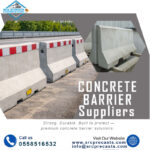

A Jersey barrier does not look very glamorous. It is located on the side of the road, no one lights their headlights on it in a good week, and it performs its function in an instant a car veers off course. It’s precisely this one moment that makes the manufacturing and testing of precast safety barriers more important than most people realize.
The Purpose of a Precast Safety Barrier
A precast concrete safety barrier is intended to deflect a vehicle from hitting it and hitting it again or going through it. Good barriers act in a gradual fashion if struck by a vehicle, absorbing and redirecting the force of impact in a controlled manner, as opposed to shocking the vehicle to a halt with a violent impact that would be much more hazardous to those inside.
These barriers are not just crash barriers; they serve a dual purpose on UAE construction and road projects. Among the reasons they’re so prevalent today are for traffic control, flood control, site security and perimeter protection.
Standard Dimensions and Shapes
Jersey barriers are available in fairly standard sizes throughout the industry but can be modified by the manufacturers for special applications. The standard sizes are 810 mm high, 600 mm at the base and approximately 3,050 mm in length, although special sizes can be manufactured as needed for specific projects.
Form is as important as size. The classic Jersey profile is used for standard impact situations, while the F-shape barrier is for more extreme impact events for a wider range of on-highway applications, with different deflection characteristics for higher speed, higher consequence roads.
Orientation matters too. Double-sided barriers are appropriate for highway medians, where both sides are subjected to live traffic, while single-sided barriers are suitable for an urban road edge or construction site where traffic flows on one side and the other side is against a fixed surface.
The Science Behind Crash Testing Standards and Why They’re Not Optional
This is the distinction between a real safety barrier and a decorative concrete block that is simply the right shape. Barriers installed on real roads must be tested and rated to meet known impact standards, not simply be constructed to resemble a Jersey barrier.
This is normally in compliance with AASHTO and MASH internationally, and the barriers are rated by Test Level, which can range from Test Level 3 to Test Level 4 according to the road speed and traffic characteristics they are intended to defend against. In response to the high-speed demands of regional highways in the UAE and GCC, some suppliers take special care to provide MASH TL4 rated barriers for customers’ higher severity demands.
Make sure you ask your supplier directly what Test Level the barrier has actually been tested to. No matter how much two barriers look alike when they’re side-by-side, a barrier rated for a low-speed work zone doesn’t belong in a highway median.
RTA and Municipality Approval Requirements
Unlike in some countries, barriers are not simply a matter of manufacturer preference on public roads in the UAE. They must comply with the specifications determined by the relevant road authority. Major projects demonstrate the magnitude of this undertaking. The Emirates Road capacity improvement project, which involves six directional bridges spanning 12.6 kilometres and is a project of approximately AED 750 million that started in September 2025, requires thousands of barrier units, all of which must meet specifications and standards established by the RTA and Municipality.
This is far from unique to mega-projects. All barriers intended for use on public roads, urban edge protection or highway medians in the UAE should comply with the requirements of the RTA or the relevant municipal authority and should have documented evidence of that compliance. Include this confirmation in writing from your supplier, particularly when ordering anything beyond temporary construction use.
Where Precast Barriers Are Used on UAE Roads
Precast concrete barriers are not a niche product in the UAE. They are an integral part of some of the country’s busiest roads. Jersey-style barriers can be seen on major highways such as Sheikh Zayed Road, E311 (Emirates Road) and E611 (Dubai Bypass), where permanent installations protect high-speed traffic and barrier performance is critical.
When evaluating a supplier, this context matters. A manufacturer with experience supplying barriers for major highway projects has a proven performance record. A manufacturer that has supplied only low-speed construction sites or temporary perimeters has not necessarily demonstrated the same level of capability.
New vs. Used Barriers: Which Should You Choose?
Not every project requires new barrier stock, and many projects consider refurbished barriers to reduce costs. This can be a practical solution, provided appropriate inspections are carried out and documented to verify the structural condition and continued suitability of the barriers.
Ask your supplier to explain exactly how previously used barriers are inspected, including checks for hairline cracks, reinforcement exposure and previous impact damage. If the supplier cannot clearly explain the inspection process, then you are simply relying on assumptions rather than documented quality control.
Interlocking and Alignment for Long Barrier Runs
Barrier installations along highways or large construction zones must function as one continuous protective system. Most precast concrete barriers incorporate interlocking systems that improve alignment and stability across long installations.
Ask your supplier how their interlocking system functions and whether it is designed to maintain system integrity if one section experiences an impact. Poorly designed connections may allow individual barriers to shift or separate, reducing the overall effectiveness of the installation.
Recognize the Red Flags
Several warning signs commonly appear among lower-quality safety barrier suppliers. Watch for the absence of crash-test documentation or Test Level certification, no evidence of RTA or municipal approval for public road applications, unclear inspection procedures for refurbished barriers, and no documentation explaining how the barrier sections interlock.
None of these issues alone should automatically eliminate a supplier. However, when two or three appear together, they provide a strong reason to investigate further before purchasing a product that is intended to protect lives.
The Bottom Line on Precast Safety Barriers
Selecting the right precast safety barrier in the UAE means matching the barrier profile, dimensions and crash rating to the actual speed and traffic conditions of the road it is designed to protect. It also means confirming approval from the RTA or the relevant municipality and understanding the inspection process if refurbished barriers are being supplied.
Ignore these checks, and you risk relying on a barrier that looks correct but may never have been properly tested for the one moment that truly matters. Get it right, and the barrier quietly performs the job it was designed to do—standing ready to protect lives whenever it is needed.