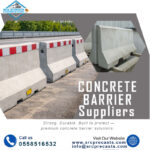
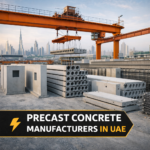
One of the most well-known types of road safety infrastructure in the UAE is jersey barriers. Whether they’re used along a highway median or as a construction site boundary, they are sturdy, concrete units that isolate vehicles, workers and pedestrians when a painted line isn’t enough. Whether you’re looking to hire jersey barriers for a road project, construction site, or temporary event space in Dubai or anywhere in the Emirates, knowing exactly what they are and what to expect when ordering them will help you make the right decision.
Precast Concrete Jersey Barriers: What Are They?
A jersey barrier is a modular concrete unit with a unique narrow top and sloped bottom. It’s not a decorative shape but a designed shape. The inclined bottom part of the face will push back the tyre of the vehicle on impact and decrease the likelihood of it jumping or rolling over the rim. The design has proven to be popular for use in traffic separation and impact protection for highways, city roads, and active work zones.
Jersey barriers are precast, not cast in place, so they are cured at the factory for immediate installation at the site. No formwork, no curing delays, and no weather-dependent pour schedules — just deliver, position and connect.
The Placement of Jersey Barriers
Precast jersey barriers can be seen in various applications throughout the construction and infrastructure sector in the UAE:
1. Highway and Road Medians
Medians between opposing traffic streams on multi-lane roads, helping to prevent head-on collisions.
2. Construction Site Perimeters
Establishing a physical separation between active construction sites and areas for pedestrian traffic or roadways.
3. Temporary Traffic Diversions
Directing cars around lane closures, road construction or phased construction projects without the expense of permanent wall barriers.
4. Airport and Port Facilities
Regulating access to and movement around restricted and/or high-security areas.
5. Event and Crowd Management Sites
Creating a secure and stable perimeter for large-scale events.
6. Parking Structures and Industrial Yards
Accidental impact protection of building edges, equipment, or storage areas from vehicle traffic.
Important Factors to Consider When Selecting Jersey Barriers
All precast barriers are not created equal. These are the characteristics to look out for when assessing suppliers:
Impact Resistance
The barrier must be designed and constructed from dense, well-compacted concrete that will absorb vehicle impact without cracking or shifting out of position.
Interlocking Connections
Modern jersey barriers are made with pin-and-loop or similar interlocking systems so that units can be joined together in a continuous run, eliminating gaps that a vehicle might otherwise pass through.
Consistent Dimensional Accuracy
Precast production in a factory environment results in consistent dimensional accuracy for every unit, which is essential for the alignment of long barrier runs.
Cast-in Lifting Anchors
Built-in lifting points enable barriers to be safely and efficiently moved using standard site equipment, accelerating installation and removal.
Reflective or Paintable Surfaces
Many projects require reflective or paintable surfaces to enhance visibility in low-light environments, especially on busy roadways.
Reusability
Jersey barriers are precast and are not damaged when removed. They can be lifted, relocated and installed at another project location or a different site altogether.
Standards and Regulatory Compliance in UAE
The precast concrete products supplied for use in Dubai are subject to the guidelines of Dubai Municipality Administrative Decision No. 316/2012 for the Approval and Use of Precast Concrete Elements in Construction Works. Dubai market manufacturers of precast units are required to have a valid DCLD-CQPS Certificate of Conformity, which certifies that their production processes and products meet the required quality standards.
In addition to local regulations, a good manufacturer will follow the principles of a number of British Standards relating to concrete strength, durability and quality control in concrete, applying them during batching, casting and curing.
It is important to ensure that for any project involving public infrastructure, private development or temporary site works, your barrier supplier can provide documentation supporting compliance with local regulations and the standards of the concrete mix design.
Why Choose Precast Over Cast-in-Place Barriers?
The benefits of precast jersey barriers compared to cast-in-place barriers are numerous:
Quicker Installation
Units can be installed immediately upon delivery, with no on-site curing time required.
Quality Consistency
Batching and curing conditions are better controlled in the factory than on-site, resulting in a more consistent and predictable product.
Reduced Site Interference
No wet concrete on site, no formwork, and no extended lane or area closures caused by concrete curing.
Economy Through Reuse
The same units can be lifted, moved and reused across multiple projects or different construction phases, reducing overall project costs.
Solid Rock Concrete Works: Providing Jersey Barriers for the UAE Market
Solid Rock Concrete Works is based in Umm Al Quwain, UAE , and supplies precast concrete products throughout the UAE for the construction, infrastructure and road safety markets. Manufactured under controlled factory conditions, our jersey barriers satisfy the durability and impact resistance specifications required for road and site safety projects.
Whether you’re building a road median, creating a temporary construction enclosure, or working on any project requiring reliable barriers that comply with roadway regulatory requirements, contact us to discuss your specifications and delivery schedule.