




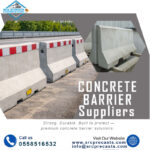

A barrier that is supposed to remain in the highway median for the next two decades should be designed in a way different than a barrier that is to be moved on a weekly basis while the road is being widened. But if you mix the two up, you’ll be paying a lot more than you’re getting, or you’ll underbuild something that’s supposed to be protecting drivers for decades. It’s the differences between the two, and how that should influence the whole purchase, that we’re tackling here.
Permanent and Temporary Barriers Address Different Issues
The choice of temporary versus permanent concrete barrier is not a decision based on which is cheaper, or is available, but rather which is the more appropriate choice for your project’s scope, duration, and safety objectives. Temporary barriers are used for short-term projects, such as construction areas, special events, or detours and are designed for rapid setup, portability, and versatility. The permanent barriers, of course, are intended to separate opposing traffic lanes for a long period of time, thereby lowering the number of head-on collisions on multi-lane highways where the barrier will not be removed for years.
These two categories may be able to use the same base material and Jersey or F-shape profiles technically. The difference is in how they are installed, anchored and connected and this can make a real difference in terms of safety if they are not used in the right application.
Depending on the Situation, the Engineering Solution May Involve an Anchored or Free-Standing Approach
This is the only major technical difference between the two groups. A permanent barrier is normally attached to the pavement or foundation, making it stable and secure enough to remain in place even with repeated impacts over its useful life. A temporary barrier is usually intended to be unanchored or lightly anchored, just so it can be moved around as projects proceed.
Some systems make a point of separating the halves. For example, one tunnel and bridge barrier system can be installed as a free-standing or anchored barrier, providing flexibility to all contractors for temporary applications with changing site conditions. However, most permanent highway facilities cannot afford to. Anchoring must form part of the design from the outset, not be an afterthought.
Deflection Behavior: Less Motion is Not Always Better—But It Is for Permanent Use
All barriers rebound slightly when struck and deflection is important in determining the location of use. This is defined as an industry spectrum, ranging from cast-in-place barriers with the lowest deflection to precast non-pinned barriers with the highest deflection.
Typically there is not a lot of room between opposing lanes of traffic on UAE highways, so the permanent median barriers require relatively low deflection. Temporary work-zone barriers, on the other hand, can be made to bend more, as the area behind the barrier is typically more flexible and needs to be moved and set up quickly instead of with a high degree of stiffness. Obtain from your supplier which part of this deflection continuum your barrier falls into and ensure that this is not the same as the general “barrier” label given by your project.
The Lengths of the Segments and the Ways They Connect Are Different as Well
Permanent and temporary barriers can be in a variety of standard segment lengths due to their different installation logic. Some permanent barrier systems are typically provided in a longer length (around 30 feet), and a few lower-profile temporary barrier systems utilize 20-foot systems (segments) which are discouraged for permanent barrier applications where continuity is most important.
Temporary systems are also likely to feature quick-connect coupling that will enable fast, easy assembly and, later, decommissioning, and often a fully integrated proprietary system that necessitates no additional components. Permanent installations are more about creating links, which are designed to be structurally continuous rather than easily pulled apart, and they’re not supposed to be easily pulled apart.
Both Use Reinforcement Standards, with Different Stakes
Precast barriers are either permanent or temporary, and are designed with internal reinforcement to resist impact. A steel rebar or wire-mesh barrier is usually reinforced to provide extra strength, durability and impact resistance, protecting the barrier from collisions and satisfying safety standards for permanent and temporary traffic control applications.
It’s not about the principles of construction but about the consequences. A temporary barrier that is less effective is flagged and replaced relatively quickly as it is on a regular rotation for inspection and relocation. No one is regularly uprooting a permanent barrier with a reinforcement failure to inspect for years afterwards. That’s precisely the reason why the specification of permanent barriers is worth more study, NOT less!
While the Same Rules Apply to Crash Testing, the Placement Rules Are Tougher When It Comes to Permanent Use
Each of these classes of barriers must be tested to known safety standards, typically under a program such as NCHRP 350 or the MASH program, and categories define the types of barriers including the New Jersey barrier and Type-F barrier profile. The problem with permanent installations is that placement guidelines become more precise. The width and slope of the median and the availability of deflection space determine the type of barrier that is recommended by highway design manuals; for a precast concrete barrier, only barriers that can be deflected may be used at locations with relatively flat slopes on the median and at sites with a sufficient distance for deflection.
That sort of site-specific engineering rarely is applied with the same level of rigor to a short-term work zone barrier that is installed and removed in a short span of time to be ready to move to another site for the next project. Permanent barrier placement, on the other hand, is more of a practical engineering assignment that is dependent on your particular corridor geometry.
The UAE’s Road Projects in Particular Are Likely to Be Impacted by the Decision
Along key highways such as Sheikh Zayed Road, E311 and E611, the UAE’s road infrastructure is reliant upon permanent Jersey-style barriers designed for high-speed, high-volume traffic scenarios where the failure of barriers has grave implications. Thousands of units of barriers will be needed, with each unit having to be specified by the RTA and the Municipality, as it is not as simple as a random purchase – barrier procurement is a regulated and engineered process in Dubai.
If your project will be a permanent median or edge protection on a public road, allow time for RTA or municipal specification review and do not presume that the supplier’s best temporary median or edge product can simply be installed as a permanent anchoring system.
Recognize the Red Flags Precast Barriers
Some red flags are relevant to assessing a permanent barrier supplier. No clear anchoring detail or foundation specification, no deflection classification, no product line information for segment length except from temporary product lines, and no willingness to confirm RTA or municipal approval for public road use.
None of these should automatically be considered as a disqualification for a supplier. But, when two or three appear together, it’s a good enough reason to pause and think carefully before committing to a barrier that is expected to remain in service for decades.
The Bottom Line on Precast Barriers
The permanent and temporary precast barriers may appear to look alike when standing side by side, but they are based on different assumptions: one is going to be removed in the near future, while the other is not going to be removed at all. For a permanent installation, it’s much more important to get anchoring, deflection classification and regulatory approval correct because those decisions will remain in place for years. Match the barrier type to its intended purpose, and it will do exactly what it was designed to do—stand where it’s installed and continue protecting the road for as long as required.