A T-wall does not want to be asked for much. No long days of setting in the field, no army of formwork carpenters. Only a crane, a level surface and a design that is designed to be on its own. This ease of use is what has made T-walls the preferred solution in military, industrial and infrastructure projects for security and containment. Let’s take a closer look at the UAE precast T-wall production and installation process, and its true effectiveness.
The Truth About a T-Wall.The Real Story About a T-Wall
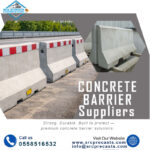
A T-wall is a precast concrete wall barrier with a special T-shaped shape and a thick base, which allows it to be stable without requiring anchoring or pouring concrete on the base. The base serves the purpose of a foundation and protects against tipping by its own weight and footprint.
This design isn’t new or experimental. Originally developed for military use (e.g. T-walls), or “Bremer walls,” they have become widely used for blast protection in the Middle East and are now being used in commercial, industrial, and security applications all over the area.
Why the T-Shape Matters
The form isn’t only for aesthetic purposes. The wide base at the toe of the T provides a lateral stability to the foundation against horizontal pressure whether from the wind or impact or from blast or the weight of the soil behind the footing, as in a cantilever retaining wall.
This is exactly why T-walls are chosen for projects that require a speedy perimeter security or containment without the time and cost of conventional foundation work, as the wall is self-supporting and can be placed directly on a level ground surface.
Determine the Mixture Proportions for Strength and Durability
The concrete mix is the first step in manufacturing and, in the case of T-walls, a high strength reinforced concrete mix will be employed rather than a standard structural mix. Precast T-walls can be produced in standard high strength grades up to ultra-high performance concrete (UHPC) with a strength greater than 20,000 PSI for critical blast-resistant applications.
Fiber reinforcement, extra steel rebar and a low water-to-cement ratio are all features commonly found in the manufacture of security and blast-rated walls, and are designed to increase strength and durability when subjected to a sudden impact load. In UAE conditions where concrete is subject to high temperature, humidity and occasional exposure to sea salt, mix design must also consider durability over the long term rather than just maximum strength on day one.
The Second Step Is Reinforcement Cage Fabrication
Before pouring concrete, the concrete’s steel reinforcement cage is constructed inside the mold. This cage is usually a mix of vertical and horizontal rebar that are sized to the height of the wall and the design load, and provides the tensile strength that just a concrete wall cannot give.
The density of reinforcement becomes much greater than that for a perimeter wall when it comes to blast-rated or ballistic-rated T-walls because the reinforcement is required to resist more than just the static load from the concrete.
Take the Mold and Cast the Wax Form in Step 3
T-walls are cast in a specially designed mold to create the T cross-section in a single pour, unlike other wall and base elements that are then joined together afterwards. This one-pour method is the same that provides the self-supporting strength of the completed unit; the wall and base are one solid structural element, and not two parts that are bolted together.
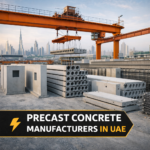
The manufacturing takes place in a controlled factory environment, an important consideration. The controlled environment of casting also provides a guarantee of precision and consistency, and quality which would be hard to achieve in on-site, cast-in-place construction, particularly in the UAE’s sweltering summer weather that can lead to uncontrolled curing conditions that can severely affect concrete quality.
Step 4: Curing
T-wall units are cured to the desired compressive strength within a controlled environment before they leave the factory. Rushing the curing stage, especially in the case of high strength or ultra-high performance mixes, calls attention to the conditions under which the mix was being cured.
The unit only will move for quality inspection and then for dispatch, once the concrete has attained adequate strength.
The Final Step Is to Carry Out Quality Control and Certification
Reputable T-wall manufacturers have their units subjected to testing against standards, often to the ASTM manufacturing standards for structural and material quality. Depending on the risk classification of the project, further certification for security and/or blast performance against the recognised standards may also apply.
Units are usually checked for dimensional, strength and surface defects before being dispatched, preventing any faults from becoming a client issue at site.
In Step 6, the Student Will Transport and Install Objects
It is here that the T-walls really stand out from the pre-cast walls. Each unit is self supporting, which means that when it is installed it requires no excavation, no anchoring bolts, and no curing of a foundation; lifting with a crane or forklift and placing directly on a level surface will suffice.
Units are usually built to interlock or align snugly side to side for crews to extend the perimeter wall in sections. A full secure perimeter, depending upon the size of the project, can be delivered and complete within a few hours, as opposed to the days or weeks that it might take to pour a concrete wall to complete the secure perimeter.
When time is of the essence, whether it’s creating perimeter security around a new facility or setting up temporary flood or containment barriers before a given timeframe, that’s when speed is important.
T-Walls Are Used in the UAE for a Variety of Purposes
T-walls are visible in all projects where a secure and easily erected wall is required with no time or expense for a poured foundation. This includes perimeter security around industrial buildings, construction site boundary walls, temporary or semi-permanent barriers for events and restricted areas, and blast or containment walls for buildings dealing with hazardous materials and/or a high level of security.
Their modular, stackable configuration is also ideal for projects that require flexible configurations, for locations where the configuration of the barrier may change over time or the barrier itself may need to be moved, expanded, or reconfigured without the need to tear down and rebuild a permanent barrier.
When Selecting a T-Wall Supplier, Here Are Some Points to Consider
There are a handful of questions that distinguish a true precast manufacturer from a “generic barrier reseller.
- Inquire about their standard mix’s compressive strength and if they have a higher strength one or a blast rated one for high security projects.
- Inquire about the standards that their units are tested and certified for and ask to see the documentation and not verbal confirmation.
- Be sure that the manufacturer actually pours the T-wall as a single piece and not as individual pieces, as the strength of the T-wall is based on its self-supporting construction.
- Also inquire about their installation support – even though a good T-wall can be a well-made product, it must be prepared and installed properly to achieve the desired performance.
Bringing It Together Precast T-Walls
The one problem solved by precast T-walls: a rapid, self-supporting wall with good resistance. Every single aspect is in place from high strength mix design, reinforced casting, controlled curing and rapid crane-set to ensure a wall that stands on its own and withstands actual pressure. That precision and speed of installation is the reason why T-walls are worth specifying for projects in the UAE that require quick and reliable perimeter security or containment.