



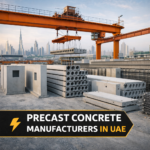
In the UAE, precast concrete manholes are widely used instead of brick manholes due to their numerous advantages.Precast Concrete Manholes UAE offer several benefits over brick manholes, making them a popular choice in the region.
There’s no one who’s been particularly enthusiastic about manholes. But, then, those engineers and project managers who decide between precast concrete and brick manholes in UAE infrastructure projects? They have a high level of concern. Because a wrong decision underground remains wrong for decades – and changing it is much more expensive than doing it right the first time.
Brick manholes were prevalent on construction sites in the UAE in the past. They were constructed by hand, one layer at a time, with the skills of mortar and masonry. But the industry has progressed onto a different level today, and that’s a good thing. This guide addresses all the major benefits of precast concrete manholes in UAE construction practices and provides verified facts as to why the industry has chosen to move away from brick and into precast concrete manholes.
What makes this comparison worth having Precast Concrete Manholes?
The underground access chamber can be constructed in either precast concrete or brick masonry. But why is it so important to choose in the UAE in particular?
Three reasons. The soils of the UAE are aggressive. Its ambient temperatures are extremely hot and cold. And its infrastructure projects are moving at a brisk pace. Brick manholes have a problem with each of those three.Precast concrete has none of those three problems. Recognizing those pressures and the rest of the comparison makes sense.
Stronger structure, load-bearing performance
Precast manholes can be manufactured for H-20 heavy traffic with a capacity of 32,000 lbs/axle load. The ability to carry the traffic and exterior soils is provided by the inherent structural properties of the concrete.
Brick manholes, on the other hand, enjoy structural performance based on brick and mortar joint integrity. This is a basically weaker one for a given sustained traffic loading. In the UAE traffic on the roads include heavy trucks, construction machinery, and increasingly the population of urban traffic. Road crossings have dynamic loads that continuously cycle with a manhole, which the mortar joints were not created to withstand indefinitely in Dubai Industrial City or on a logistics corridor in Abu Dhabi.
The cracks that appear in the brick and mortar are the first signs of failure; even the smallest crack can have a huge impact. Seeder-water from leaking manholes has been found to be a significant cause of sewer back-ups, and a continuous cost for wastewater treatment plants.
Precast concrete eliminates this failure mode as the wall of the chamber is a single dense, reinforced piece, rather than hundreds of individual mortared pieces.
The factory Quality Control and Site-Built Uncertainty
This is perhaps the most important benefit of precast concrete manholes in UAE projects and can be overlooked during the procurement process.
The quality control process is a major component of each stage of the precast production process. A full automation mixing machine is used to create a totally uniform concrete mix. Cast compressive strength cylinders, air content and slump are measured and recorded. All precast products are monitored to ensure full design strength is met prior to being put into inventory and/or job site.
This is what brick manholes can’t provide. Though the construction is done on site by hand in open excavations, the skill level of the operatives varies. There are site conditions for which the mortar mixing ratios vary. Curing is dependent on the outside temperature and climate. The joint strength and porosity in the mortar are reduced as a consequence of rapid curing of the site mixed mortar in the hot summertime weather conditions in the UAE, which often reaches more than 45°C.
Advantages of precast over site-built products include the ability to create quality products consistently with the advances of the additive technology. The low permeability of precast concrete is formed due to low water-cement ratio, and has a longer service life.
In addition, each manhole precast that is manufactured from the yard has test data recorded. Your quality engineer needs to review it. A brick manhole is completely dependent on the mason who constructed it – and when you discover a problem, it’s too late as it’s already been backfilled.
Water Tightness and Resistance to Groundwater Infiltrations
In the UAE it is not a theoretical issue. In some parts of Dubai and Abu Dhabi, groundwater is shallow and in coastal areas, groundwater contains high levels of chloride and sulphate. Over time, a manhole opening which allows groundwater to enter a sewage system increases in volume, raises treatment expenses and corrodes the system’s inner walls.
Fired Ceramic Brick is resistant to corrosive attack, but the surrounding mortar will degrade over the years, particularly due to biogenic sulphide attack. Brick manholes were the most frequent rehabilitation problem identified and it is a problem that often results in structural issues and allows easy groundwater entry.
Precast Concrete Manholes feature rubber gasket spigot-and-socket jointing which allows for a consistent and factory-tested seal between rings. In the UAE, watertightness is tested according to BS EN 1917, which is the most widely used standard for precast manholes, by testing against a head of water of five metres for 15 minutes. That is a documented measureable performance standard. There is no equivalent criterion in the factory testing of brick manholes, since they are not manufactured products.
The mortar of the Portland cement joint to which the bricks are attached, is affected by the corrosive atmosphere that exists beneath the earth. Consequently, the most frequent rehabilitation problem in brick manholes is the lack of mortar between the bricks allowing groundwater to enter and causing structural deterioration.
This is exacerbated by the UAE’s highly saline soils that are rich in sulphates. There is a well established history of the occurrence of sulphate attack on Portland cement mortar in the region and such attack has been identified as one of the motivating factors for the Dubai Municipality construction specifications for underground works, which generally require the use of dense concrete, with sulphate resistant mix designs, rather than brick masonry, for drainage structures.
Speed of Installation
Construction time in UAE is limited. Permits are required for road closures. The hour of traffic management is expensive. It is desirable for the drainage contractor to quickly install the manhole and restore the road surface.
Precast concrete manholes are a great way to cut down on jobsite work. These structures come to the construction site pre-made, which eliminates the need for extensive formwork, reinforcement placement, and concrete pouring usually required with a cast in place method. This is a streamlined approach, thereby reducing work effort.
When it’s precast, there’s no need to wait 24 to 48 hours for cast-in-place concrete to dry and set, and backfilling takes place the first or second day. As you can see from the whole picture, a precast crew is done and on to the next one before a traditional method crew is even started.
A brick manhole, however, must be visited at the site multiple times, allowed to cure mortar during the duration of time, performed benching work, and undergo internal finishing before it can be backfilled. Each day that the excavation site is open on UAE roadway projects or in a residential or commercial development is a day of risk, disruption and cost.
Durability Over The UAE’s Design Life Expectations
In the UAE, infrastructure needs to be designed to last. Master planned communities, highway networks and utility corridors have 50 to 100 year service life. A 20-year-old manhole in need of rehabilitation/replacement is a problem for any asset owner.
Even with limited maintenance, most precast concrete structures will last 100 years. This is typically much longer than other materials, especially when buildings are subjected to pressure, vibration and dampness.
The manhole found in old facilities is generally over 50 years old. Extended Service results in a very deteriorated mortar joint or possibly the complete absence of the same. Inspections frequently reveal that the bricks have become missing, the bricks are not constructed properly, and infiltration occurs through the missing joints.
There is a stark contrast in this. If the manhole is well designed for the UAE climatic conditions (using sulphate-resistant cement, low water-cement ratio, proper cover to reinforcement), and is manufactured to the correct specifications, it can structurally last the entire design life without needing rehabilitation. In aggressive ground conditions, brick manholes will generally need to be intervened on long before that time.
Reduced Labour Dependency
There is not as much availability of bricklayers with a solid background in manhole construction as before in the UAE projects. Labour markets in the Emirates are competitive and trade in specialization is costly. An experienced brick manhole that is installed in a confined space at depth costs, is risky, and is dependent on time.
There will be fewer operatives on site during precast concrete installations. Finished sections of the manhole are delivered. The rings are placed using a lifting frame or crane. The process of joint sealing is simple. If necessary, benching is often done in the factory base unit. The operation is more repeatable, less dependent on the skill levels of the craftsperson.
The amount of site labour required to build one cast in place or brick manhole can be enough to generate 20 or 30 precast manholes in the same amount of time in the factory. This is a unique benefit in terms of accuracy, consistency and quality.
A supportive environment and sustainability credentials
It is more important in UAE projects than ever before. Sustainability is not only being added to the procurement agenda for buildings but also for civil infrastructure, owing to Dubai’s Green Building Regulations, Abu Dhabi’s Estidama framework, and rising client ESG requirements.
Concrete is a natural and non-toxic product that is environmentally friendly. The concrete is a popular choice for businesses aiming for LEED certification because it requires little disturbance of the site during installation and provides good control of stormwater runoff. Regional materials are used in concrete products, which are more environmentally friendly.
The volume of site waste associated with Brick manholes is much greater than on other manholes, as the bricks, bags of cement and the mortar mixing debris are all site waste requiring collection and disposal. Precast concrete manholes are delivered ready to use and virtually waste-free. It’s significant for both site maintenance and sustainability reporting.
The traditional brick manholes do not leave sufficient bricks in the hole and it is difficult to dispose of the cement waste material during the construction stage, which has great impact on the local environment.
Adhering to UAE Regulatory Frameworks
Underground access chambers are cited by Dubai Municipality, Abu Dhabi Sewerage Services and Etisalat/du telecom as standards and quality assurance requirements for the products. Manholes produced in line with BS EN 1917 and ISO 9001:2015 quality management system are a natural fit for these systems.
Manhole suppliers in UAE, based in Dubai and Abu Dhabi, are manufacturing manholes for both private and public construction projects. They supply products that have documented test data, marked conformity and clear provenance, aiding the formal approval and inspection processes that UAE regulatory authorities require.
By their very nature, Brick manholes are site built, and therefore cannot offer the same degree of pre-construction documentation and quality assurance. In regulated UAE utility projects, that is a key drawback.
The Practical Conclusion
The move from brick to precast concrete manholes in UAE is not a trend. It is logical in relation to the climatic, soil, construction speed and infrastructure goals of the region. The advantages of precast concrete manholes in UAE projects are consistent, they are verifiable, and they are the benefits that engineers and contractors would find if they did a honest comparison between the two methods.
There was a time when brick manholes were in vogue. It did not affect their mortar joints very much. Precast concrete, made in controlled environments, tested to formal standards and built for 100 years is just the answer to the infrastructure that the UAE is creating and maintaining today.