


If you’ve ever admired the sleek façade of a modern office tower or the smooth curvature of a pedestrian bridge, chances are you’ve seen precast concrete in action. But what exactly goes on inside a precast concrete plant—how do those massive panels, beams, and arch segments come to life? The answer lies in a well-coordinated precast concrete manufacturing process that blends engineering precision with industrial efficiency.
In this article, we’ll walk through the entire journey from raw materials to finished product. Along the way, you’ll discover real-world examples, practical insights, and the key steps that set high-quality precast concrete apart from on-site casting.
Why Precast Concrete Matters
Before diving into the nuts and bolts of fabrication, it’s worth understanding why the industry favors precast over traditional poured concrete:
Speed: A precast panel can be ready within days, cutting construction timelines by 30-40%.
Quality Control: Factory settings offer better control over curing conditions and material consistency.
Safety: Less on-site labor reduces exposure to hazards.
Design Freedom: Complex shapes—arches, curves, and decorative panels—are easier to fabricate in a controlled environment.
These benefits make precast concrete a staple in bridges, parking structures, high-rise façades, and even residential slabs.
The Core of the Journey: Precast Concrete Production
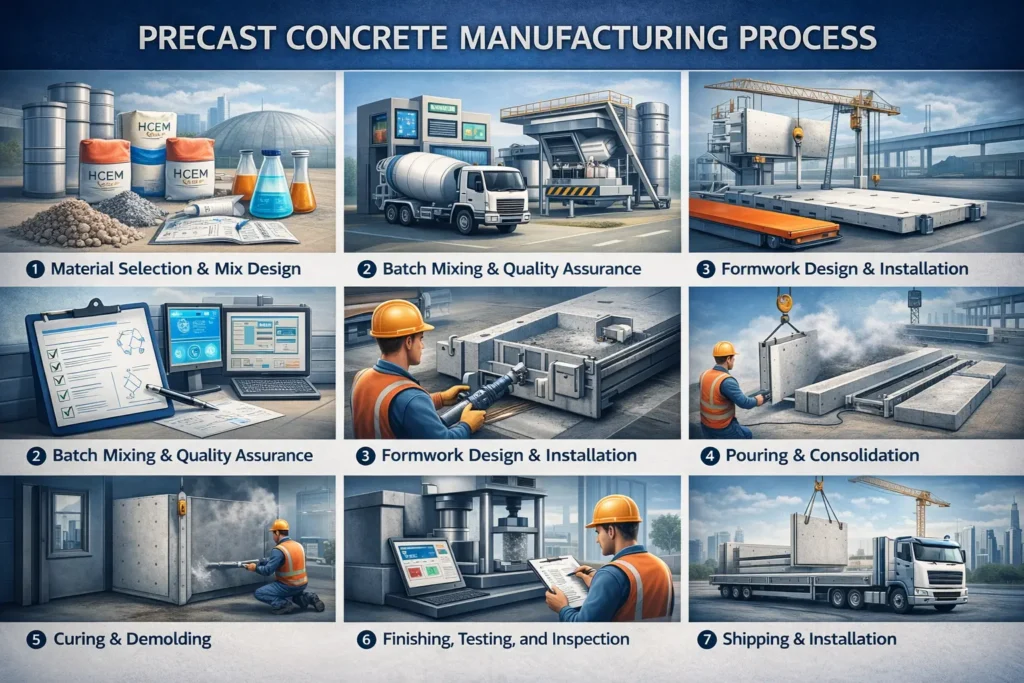
Let’s break down the precast concrete manufacturing process into its fundamental stages. Each step builds on the last, ensuring that the final component meets structural, aesthetic, and durability requirements.
1. Material Selection & Mix Design
Aggregates: Crushed stone, sand, or recycled materials are chosen based on the required strength and workability.
Cement: Ordinary Portland cement (OPC) is common, but specialty blends (e.g., high-strength, low-CO₂) are used for specific applications.
Admixtures: Retarders, accelerators, water-reducers, and air-entrainers tailor the mix’s performance.
Water: Clean, potable water is mandatory to avoid contamination.
A skilled mix engineer creates a formula that satisfies the project’s compressive strength (e.g., 40–60 MPa), durability, and finishing characteristics. The mix is tested multiple times before production starts, ensuring no surprises during casting.
Real-world tip: The bridge in Portland, Oregon, uses a precast concrete mix with high alumina cement for rapid strength gain—perfect for tight construction schedules.
2. Batch Mixing & Quality Assurance
Once the recipe is set, the precast concrete plant’s batching plant blends the components. Modern plants use automated weigh-scales and sensor-based controllers that keep each batch within ±2% of the target mix.
Batching accuracy guarantees that every panel shares the same strength profile.
Temperature control prevents premature setting or weakening due to heat buildup.
After mixing, the concrete is poured into the formwork.
3. Formwork Design & Installation
The formwork, or mold, determines the final shape. Precast plants use a variety of form systems:
Frame Forms for simple rectangular panels.
Custom Molds for arches, curves, and ornamental shapes.
Interlocking Forms for large panels that need to be transported safely.
Precision in formwork design is critical; slight misalignments can lead to structural issues or costly rework.
4. Pouring & Consolidation
Concrete is poured into the form using conveyors, pumps, or manual labor. A few key techniques ensure the mix fills every cavity:
Vibration: Low-frequency vibrators compact the mix, eliminating air pockets.
Screw-type pumps for tight spaces or high-rise panels.
Gravity pouring for large, horizontal panels.
5. Curing & Demolding
Curing is the secret sauce that turns wet concrete into a hardened, durable material. In precast plants, curing is controlled with:
Steam Curing for high-strength mixes in a few hours.
Water-Curing Tanks for standard strength components.
Dry-Cure Mesh for panels that will be stored before transportation.
The curing cycle typically lasts 7–28 days, depending on the mix and environmental conditions. After curing, the formwork is removed carefully to preserve surface finish.
6. Finishing, Testing, and Inspection
Surface Finish: Depending on architectural requirements, panels might be:
Smooth for modern, sleek façades.
Textured for a natural stone appearance.
Decorative using molds or embossing techniques.
Testing:
Compression Tests confirm the panel’s strength meets design specifications.
Water-tightness Tests for waterproofing elements.
Dimensional Checks ensure that length, width, and thickness are within tolerance.
A certified inspector signs off on each panel before it’s shipped.
7. Shipping & Installation
Transportation logistics are a critical part of the precast concrete manufacturing process:
Specialized Trucks or flatbeds with vibration-damping systems.
Planning for Load Limits—the weight of a precast panel often exceeds 3,000 kg.
On-site Preparation to receive, align, and secure the panel.
Once on site, the panel is lifted into place using cranes, bolted or anchored into the concrete structure, and grouted as needed.
LSI Keywords in Context
Precast Concrete Fabrication: The factory-based creation of structural elements.
Precast Concrete Components: Beams, columns, walls, and panels that make up a building or bridge.
Precast Concrete Manufacturing Steps: Each listed step above.
Precast Concrete Plants: The facilities where the process happens.
These terms naturally interweave with the primary keyword throughout the article, enhancing SEO without sounding forced.
Practical Insights from the Field
The Melbourne Harbor Bridge: Designed with precast concrete arches that were fabricated off-site and assembled in a single day—a record for a structure of its size.
Green City Parking Structure, Austin: Utilized precast concrete panels with embedded solar tiles, showcasing how precast can accommodate sustainable features.
The Shard, London: Its glass façade panels are precast concrete and composite panels that were fabricated in a plant in the UK and shipped worldwide.
From these projects, we glean that meticulous planning and robust quality controls are non-negotiable. Skipping a single step can cascade into delays, cost overruns, and safety risks.
Common Challenges & How to Overcome Them
| Challenge | Why It Happens | Mitigation |
|---|---|---|
| Temperature-induced cracking | Outdoor temperature swings affect curing | Use temperature-controlled curing tanks |
| Misalignment during transportation | Vibration or unexpected road conditions | Secure panels with straps and use vibration-damping transport |
| Material variability | Quality of aggregates or cement can vary | Rigorous supplier audits and on-site material testing |
| Formwork damage | Inadequate handling or design errors | Use high-strength formwork and operator training |
Addressing these issues proactively can save time and money while ensuring the final product’s integrity.
The Bottom Line
The precast concrete manufacturing process is a sophisticated ballet of engineering, material science, and logistics. From the precise mix design to the final installation, every phase contributes to a structure’s performance, durability, and beauty.
Whether you’re an architect dreaming of a sculptural façade, a contractor aiming to shorten schedules, or an engineer seeking reliable load-bearing components, understanding this process unlocks a world of possibilities.
If you’re considering precast concrete for your next project—or simply want to learn more—reach out to a local precast manufacturer today. Their expertise can help transform your vision into a concrete reality that stands the test of time.