






When a new highway rolls out of the desert, or a city street is upgraded to handle heavier traffic, the hidden hero of the project is the road base. In the UAE, where climate extremes, rapid urban growth, and engineering excellence collide, the road base construction process in UAE has become a benchmark for quality, durability, and speed. This article walks you through every step of that process, highlights local practices, and gives you real-world examples that you can apply to your own projects.
Why the Road Base Matters
Before we dive into the construction stages, let’s understand why the base layer is the backbone of any paved road:
Load distribution: It spreads vehicle loads to the sub-soil, preventing rutting and cracking.
Drainage: A properly engineered base channels water away, reducing hydroplaning risks.
Foundation stability: It creates a solid foundation that supports the surface layers over decades.
In the UAE, where temperatures can soar above 50 °C and monsoon rains flash up in the winter, a resilient base is not just a good idea—it’s a necessity.
Step-by-Step Road Base Construction Process in UAE
Below is a concise roadmap that captures the key activities, from site prep to quality control.
1. Site Survey and Sub-Soil Analysis
Geotechnical drilling: Experts extract core samples to assess bearing capacity and moisture content.
Topographic mapping: Digital elevation models (DEMs) identify slopes, drainage patterns, and potential settlement zones.
Local regulations check: UAE’s Ministry of Climate Change and Environment (MOCCAE) sets standards for road construction, which must be incorporated early.
2. Excavation and Sub-Grade Preparation
Layer removal: The existing weak material is excavated to expose a competent sub-grade.
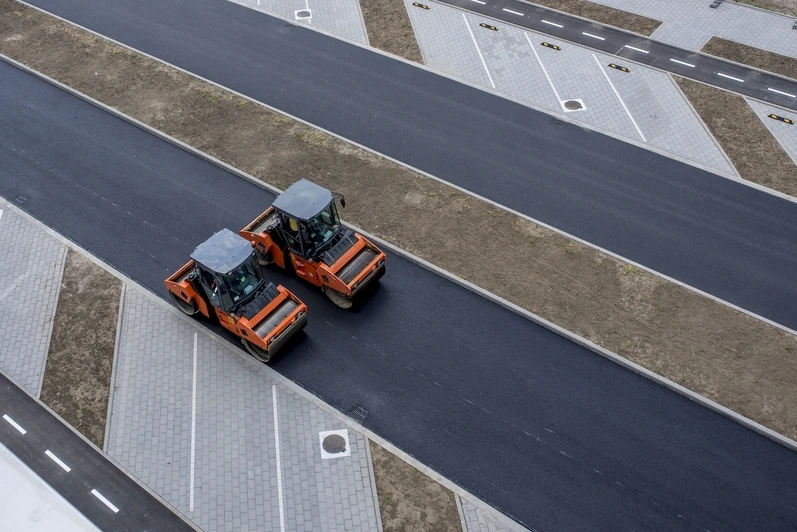
Compaction: A series of rollers—single-track, multi-track, and vibratory—ensure a density of at least 95 % of the Standard Proctor value.
Slope grading: The base is shaped to achieve a gentle slope (typically 1:20) for runoff.
3. Selecting the Base Material
In the UAE, common materials include:
Crushed aggregate (2 mm–25 mm): Offers high strength and good drainage.
Recycled concrete aggregate: Sustainable and cost-effective for secondary roads.
Geotextiles: Placed beneath the base to separate layers and enhance stability.
The choice depends on traffic volume, climate, and available resources.
4. Layering and Compaction
Primary base layer (PBL) – 200–250 mm thick:
Spread uniformly.
Compacted with a vibratory roller; target 90 % Proctor density.
Secondary base layer (SBL) – 100–150 mm thick:
Adds extra load-bearing capacity.
Compact to 95 % Proctor density.
Filter layer – 10–15 mm of geotextile:
Prevents migration of fine particles.
Enhances drainage.
5. Quality Control and Testing
Density tests: Cone penetration tests (CPT) or nuclear density gauges.
Water suction tests: Ensure adequate moisture content before compaction.
Finish checks: Surface roughness measured with a profilometer.
The UAE’s Road and Transport Authority (RTA) mandates documentation of each test to certify compliance with the “Class A” road standards.
6. Protective Cover and Final Preparations
Bitumen overlay: Once the base is verified, a bituminous layer is laid.
Markings and signage: Road markings, lanes, and safety barriers are installed.
Planting and landscaping: In UAE’s green corridor projects, roadside trees and shrubs are added to improve aesthetics and reduce wind erosion.
Real-World Example: The Dubai Metro Road Works
Dubai’s rapid expansion has seen the construction of dedicated roadways adjacent to the metro system. Here’s a snapshot of their base construction approach:
High-performance aggregates: Used for the primary base to withstand heavy metro access trucks.
Thermal imaging: During the hot months, crews monitor temperature gradients to prevent thermal cracking.
Smart compaction: Automated rollers with GPS data logging ensure uniform density across the 3 km stretch.
The result? A pavement that has remained smooth for over five years with minimal maintenance—a testament to meticulous base engineering.
Common Challenges and How to Overcome Them
| Challenge | Why It Happens | Solution |
|---|---|---|
| Waterlogging | Poor drainage design or unexpected rainfall | Install perforated drainage pipes and ensure the base is well-graded |
| Thermal Expansion | Extreme UAE temperatures | Use expansion joints and flexible overlays |
| Sub-Soil Settling | Inadequate compaction | Conduct pre-loading tests and add a pre-stressed layer |
| Material Shortage | Limited local aggregates during dry season | Diversify suppliers and consider recycled materials |
Piloting a small test section before full scale deployment has saved many UAE contractors from costly reworks. Think of it as a “dry-run” to validate your plan.
Industry Trends Shaping the Road Base Construction Process in UAE
Sustainability: Recycled aggregates and low-embodied-energy materials are gaining traction.
Digitalization: BIM (Building Information Modeling) and GIS data are integrated into planning to predict soil behavior under load.
Adaptive Materials: Self-healing polymers are being trialed to extend pavement life.
Climate Resilience: Designs now incorporate heat-reflective surfaces to curb the “urban heat island” effect.
Staying ahead of these trends not only improves project longevity but also positions you as a forward-thinking contractor in the UAE market.
Soft Call-to-Action: Ready to Upgrade Your Road Projects?
If you’re designing a road in the UAE or simply want to ensure that your pavement survives the desert’s demands, start by revisiting the road base construction process in UAE. Focus on proper sub-soil preparation, choose the right aggregate mix, and adhere to RTA’s quality standards. The payoff? Roads that last longer, traffic that moves smoother, and reduced maintenance costs.
Curious to learn more about how advanced materials can boost your next project? Contact our engineering team for a free consultation and a detailed project assessment. Let’s build roads that stand the test of time—one base layer at a time.