






Let us be honest. Few people are enthusiastic about septic tanks. But if you have a property in the UAE without access to municipal sewers (and many do) then installing a concrete septic tank is one of the most critical investments you will make. Do it right and you will not care for 25 years. Do it incorrectly and you will think about it all the time. This blog takes you through the whole process of installing the concrete septic tank UAE homeowners need to have installed, including obtaining the necessary permits and planning and site preparation, through excavation, installation and post-installation inspections. No fluff. Just the simple facts.
Concrete’s Concrete Fits UAE Residential Construction
Before we explain how to install a concrete septic tank, let’s explain why concrete is the preferred material for septic tanks in the UAE. Concrete’s strength and impermeability makes it perfect for withstanding the weight of wastewater, and the corrosive salt content in the UAE’s soil. ATN Info The arid climate, salt in the soil and high temperatures of summer significantly shorten the lifespan of these cheaper alternatives compared to what homeowners anticipate.
Unlike plastic and fiberglass, which require extra material processing to be water tight, concrete is inherently water tight. The concrete structure is water tight, so leaks are less likely. SRC Precast In the case of a residential property in the UAE, that’s not a luxury, it’s a necessity.
Step One: Determine if You Need a Concrete Septic Tank
It may seem like an open door, but this step is often overlooked. Not all regions in the UAE require septic tanks. Most urban areas of Dubai, Abu Dhabi and Sharjah have access to centralised sewer systems. Septic tanks are usually needed in suburban areas, villages, farms and new areas where the sewer system is not available.
The majority of urban and peri-urban areas in the UAE are connected to a municipal sewer network. But some rural areas still use septic tanks for wastewater disposal. Al Safrik Steel Before you spend your first dirham, check with your emirate’s municipality to see if your site needs a sewer or septic tank. A brief telephone conversation or visit to your municipality saves time, money and stress down the track.
Step Two: Know the Permitting and Approval Process
This is where many UAE homeowners fall foul. Putting in a concrete septic tank without approvals is not only a gamble, but can lead to fines, removal orders and difficulties when selling the property in the future.
According to Dubai Local Order No. 8 of 2002, nobody is allowed to set up a sewage treatment system without getting the required approval from the Competent Department. The owner shall build a septic tank for sewage water or a collection tank as per the schemes and details specified by the Ministry of Municipal and Rural Affairs which shall have the right to monitor the construction and installations during the implementation stages. TankAndBarrel
Dubai Municipality’s Sewerage Design Guidelines state: consultants must adhere to DM requirements, and DM has the right to refuse NOC for connecting to its network if the system does not meet minimum standards. Norway SepticWhat this translates to is that you require signed off drawings and a licensed engineer or contractor, as well as the municipality’s approval before you can dig. Dubai Municipality provides permits and NOCs for construction and other works and the application must include architectural, structural, and MEP drawings with the stamp of a licensed consultant. Gateway Septic
Don’t skip this step. The permitting process ensures you’re ready from a legal perspective and your system meets UAE Civil Defense and environmental requirements.
Step Three: Do a Site Survey and Size the Tank
After securing your permits, it’s time for an assessment. Don’t leave this to chance. An in-depth assessment of your site identifies the tank and field placement. It takes into account the soil type, slope and water table. GRP Tanks
In the UAE, with sandy and sometimes very salty soil, it’s crucial to know the soil conditions. The tank must be placed far enough away from existing utilities, your building’s foundation and your soakaway or drain field. Most local codes require the septic tank be at least 10 feet away from your home, but some require it to be more than that from your foundation. Other local codes dictate the location of the septic tank in relation to property boundaries. Kazemaportabletoilets
The tank’s size is also important. A septic system and tank size is based on the number of bedrooms in the household and the soil’s water flow rate. Overloading will prevent a septic system from working effectively. Dubai Municipality Concrete offers versatile sizes for UAE septic systems, ranging from 200-10,000 litres, for domestic or commercial use. ATN Info For a typical family villa in the UAE with 4-5 occupants, a properly sized tank will be in the range 3,000-5,000 litres – check with an engineer to determine the size needed for your required daily water flow.
Step Four: Excavation and Preparation
Once the permit is obtained and the size is determined, the site is excavated. This step requires precision. The ground beneath the septic tank must be flat and the hole for the tank must be the right size and depth for the tank. The ground needs to be levelled and the pipework trenches dug. Dubai Municipality
It is suggested to use 5 to 6 inches of pea gravel or sand over a well compacted and levelled base. The levelness of the tank depends on proper compaction of the soil and bedding of sand or gravel. Placing tanks on top of large stones, rocks or rocks edge can damage the tank. Dubai Municipality
The UAE can experience shifting sand after rain or in extreme temperatures. Properly compacted and levelled beds are not a convenience, but what will hold a heavy precast concrete tank in place for years.
Step Five: Installing the Concrete Septic Tank
This is the exciting step that always looks good and is, quite simply, the easiest part of the process – assuming the previous steps were done properly.
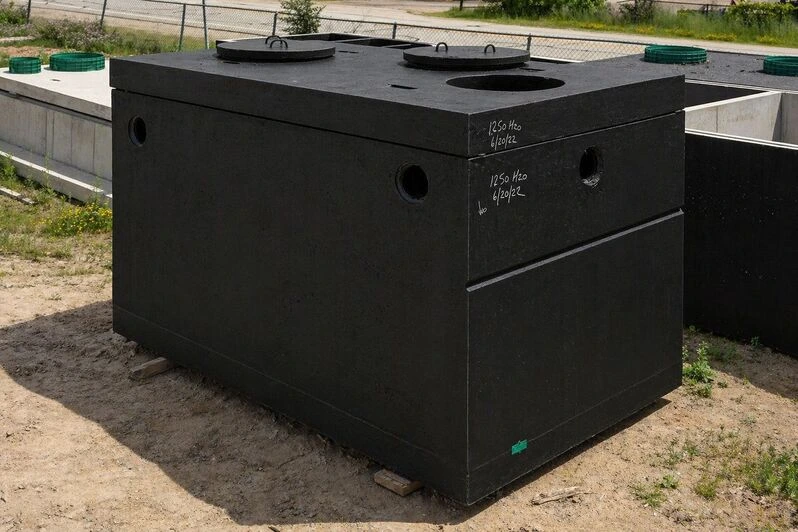
Concrete tanks may require a crane to place due to their weight. The tank will need to be positioned into the hole and checked to be level and stable before being connected to pipes. Gooxoom Precast concrete tanks are delivered installed. Precast tanks are delivered and simply dropped into the excavated area. They need to be carefully positioned to be level and secure. Jet Concrete Work
Prior to placement, check the tank’s orientation. Before placing, the tank should be oriented so the inlet openings are toward the house and the discharge into the drain field. There should be adequate access for large, fully loaded trucks. It shouldn’t have any trees, branches, rocks, power lines or other utilities that would prevent access and offloading. Dubai Municipality
Step Six: Piping and Tank Components
Once the tank is in place, it’s time to connect the pipes. Inlet pipe that carries effluent from your property to the tank must be 15 cm diameter and have a minimum of 2% slope (2 cm fall for every 1 metre of pipe) from the property to the tank. The inlet pipe should connect directly to the septic tank. The inlet pipe should be higher than the outlet pipe and the chamber transfer pipe should sit slightly lower than the inlet and outlet pipes. Atlasgrp
All the pipes must be properly aligned and sealed to avoid leaks and blockages. With the tank and pipes installed, the hole is backfilled, and the system is tested to make sure it is working properly. GRP Tanks
Manholes for access also must be installed. Manholes are provided in the cover for sludge removal and maintenance. These need to be large enough for easy access for maintenance and inspection. The diameter of manholes in residential tanks is typically 50 cm. Jet Concrete Work There should be at least two of these – a tank with no access points is a nightmare when the first maintenance guy turns up.
Step Seven: Backfill, Test and Inspect
With pipes and manholes installed and all joints secured, it’s time for backfilling. The tank is backfilled with compacted soil in layers, being careful to not disrupt the tank or pipe connections.
Once it’s backfilled, it’s time to test. In most jurisdictions, a new septic system must be inspected. The inspector confirms the system meets the septic tank installation requirements, and checks for leaks, mechanical and flooding/drainage problems. Kazema portable toilets In the UAE, this inspection by the local municipality is required. Your contractor should organise this inspection – and you should not use the system until you have a written approval.
The owner of the property in Dubai is liable for the proper functioning of the on-site sewage system. This means having them cleaned and inspected regularly. Dubai Municipality should be notified of any blockages, leaks or overflows. Dana Steel UAE
After Installation: What Comes Next
If professionally installed, a concrete septic tank UAE system in a residential property is durable. The tank will last for years – at least 25 years – so you won’t need to worry about replacing it, saving you thousands in replacement costs. Atlas Group But how you care for the system after it is installed is key to longevity.
Regularly inspect the system for problems and fix them early. Pump every 3-5 years, depending on tank size and usage. Be mindful of what you put down the toilet or drain – responsible use will ensure solids don’t build up in the system. GRP Tanks
The process of installing a concrete septic tank to a UAE home is relatively straightforward. Obtain the necessary permits, correctly size the tank, prepare the site, use a qualified contractor, and obtain approval from the municipality before using it. That is it! Everything you need to install a system that operates below the surface for a lifetime – allowing you to live your life.